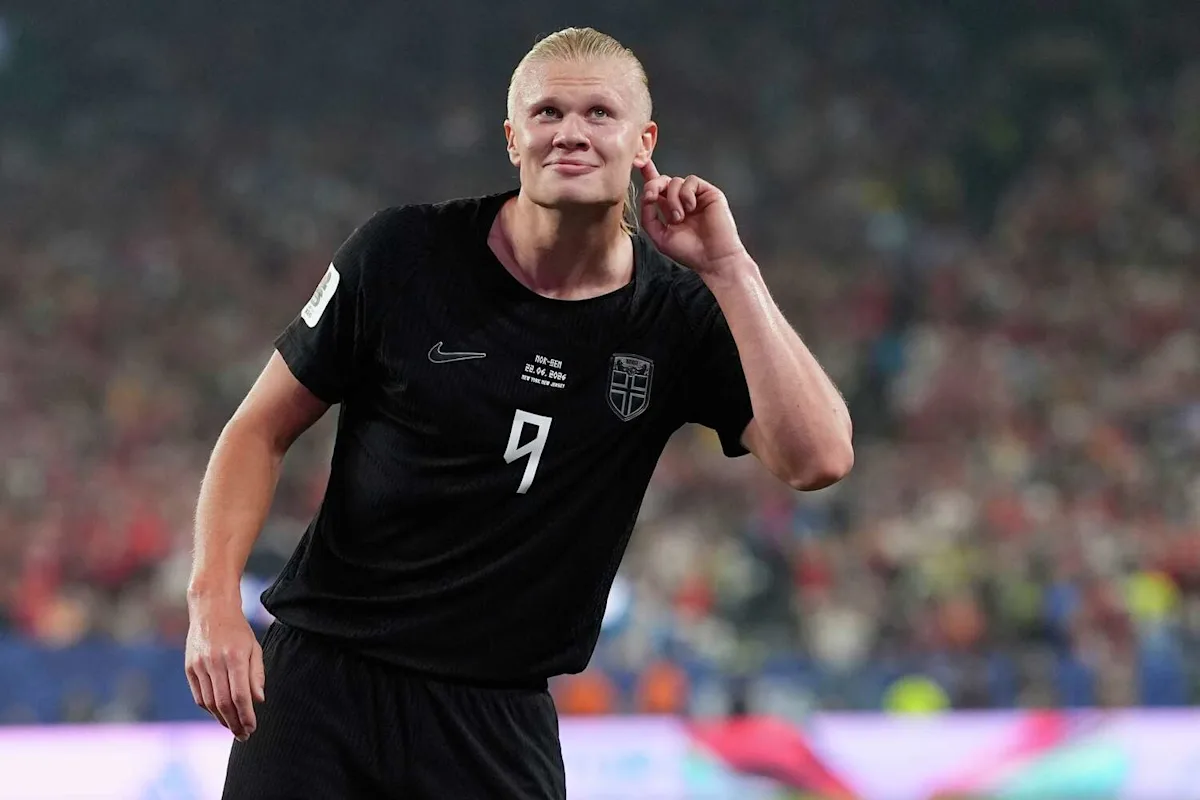
The Gentle Giant
Unlike many football superstars, Haaland has built a reputation for being a gentle giant: he is often remarkably calm, respectful, and emotionally controlled both on and off the pitch. Although he has these character traits, he still has moments of competitiveness and visible frustration; however, people around him have repeatedly described him as grounded and disciplined.
Growing Up in Bryne
Haaland was born in Leeds, England, where his father, Alf-Inge Haaland, played for Leeds United. Although he was born in England, he has always strongly identified as Norwegian. When Haaland was around three years old, he and his family moved back to Bryne, Norway. Instead of growing up in the center of English football celebrity, he spent his childhood in one of Norway’s quieter farming communities.
Children in Bryne had room to spend time outdoors, and football could be enjoyed without being treated as a cut-throat path to fame. Haaland’s youth coach, Alf Ingve Berntsen, has said the town offered a safe environment with less media attention than a major football city. That setting may have allowed Haaland to develop with less pressure and more of the freedom of a normal childhood.
His father, as previously mentioned, was a professional footballer. Rather than treating the sport as a straight path to glory, Alf-Inge appears to have given his son room to grow. Berntsen recalled that Haaland’s father attended matches like any other parent and became more involved later, when he could advise his son about behavior and career decisions.
His mother, Gry Marita Braut, competed as a heptathlete, meaning Haaland grew up with parents who understood the importance of discipline, nutrition, recovery, and work ethic. This likely helped Haaland develop and stay on track. As a youth, Haaland was energetic, funny, competitive, and yet respectful. His coach remembered him as a happy, lovable member of the group who was not treated differently from anyone else.
The Law of Jante
Norwegian culture may also have influenced Haaland, as it often strongly values modesty and equality. There is a cultural idea called the Law of Jante—not a literal law, but a social concept with roots in a satirical 1933 novel—which is commonly associated with not believing you are better than everyone else. In its more positive modern interpretation, success should be treated as a way to improve yourself rather than a reason to demand better treatment. You should be humble, respect others, and let your actions speak louder than your words.
Haaland grew up playing numerous sports, including handball, skiing, golf, and athletics, and he reportedly set a standing long-jump record for his age group when he was five. This highlights how his childhood was not centered only on becoming a footballer; rather, he was allowed to explore different activities. Even after becoming famous, Haaland’s public image often remains playful and informal. Compared with many footballers, he can seem remarkably natural.
“Greatness does not always have to be loud.”
Learning to Stay Calm
At the elite level, Haaland places visible importance on training, recovery, and preparation. One of his most defining characteristics appears to be his emotional control. Elite performers try to avoid allowing one mistake to influence the next because they need to stay focused; Haaland’s ability to reset may have been strengthened by the disciplined and low-pressure environment in which he developed. That does not make him emotionless. He is fiercely competitive and can show frustration, but he often regains his focus quickly.
He also often seems calm under pressure, with enormous moments rarely appearing to overwhelm him. Teammates, managers, and former coaches have praised Haaland’s professionalism and described him as someone who is obsessed with improving himself. He tends not to answer every criticism publicly and often lets his performances speak instead.
Even after becoming famous, family appears to remain a central priority. Haaland has spoken warmly about the love and support his parents gave him, and he continues to return to Bryne, where much of his family and many lifelong friends remain. Keeping much of that circle outside the spotlight may help preserve a sense of normal life.
Greatness Without Ego
Haaland is a powerful example of what it can mean to have a competitive drive while also staying respectful and true to yourself. He shows that strong people can absorb criticism, stay calm under pressure, and let their actions speak louder than their words. His upbringing in Bryne, the influence of his family, and the values of the community around him may help explain how he developed a strong head on his shoulders—one that can handle pressure without losing sight of who he is.
Share
Share this story
References Sources
- UEFA — Erling Haaland on growing up in Bryne, staying grounded, and the support of his parents (external link)
- Manchester City — “Erling Haaland: The Boy From Bryne,” featuring youth coach Alf Ingve Berntsen (external link)
- Manchester City — “Our Erling,” on Haaland’s continuing connection to Bryne, family, and childhood friends (external link)
- Manchester City — Official Erling Haaland player profile and biographical background (external link)
- Manchester City — “Erling Haaland: 10 things you didn’t know,” on Bryne, his athletic family, and multi-sport childhood (external link)
- FIFA — Erling Haaland profile, including his age-group standing long-jump mark (external link)
- BBC Sport — Profile of Haaland’s upbringing, mentality, and reputation for remaining the same person (external link)
- The Guardian — Profile connecting Haaland’s grounded approach with his Bryne upbringing (external link)
- The Guardian — Haaland’s youth coach on Bryne’s safe, low-pressure football environment (external link)
- VG — Haaland on his mother Gry Marita Braut’s importance and her heptathlon background (external link)
- Life in Norway — Cultural context for Janteloven, modesty, equality, and its literary origins (external link)
- TIME — Erling Haaland on family, growing up in Bryne, pressure, and the mentality of performance (external link)