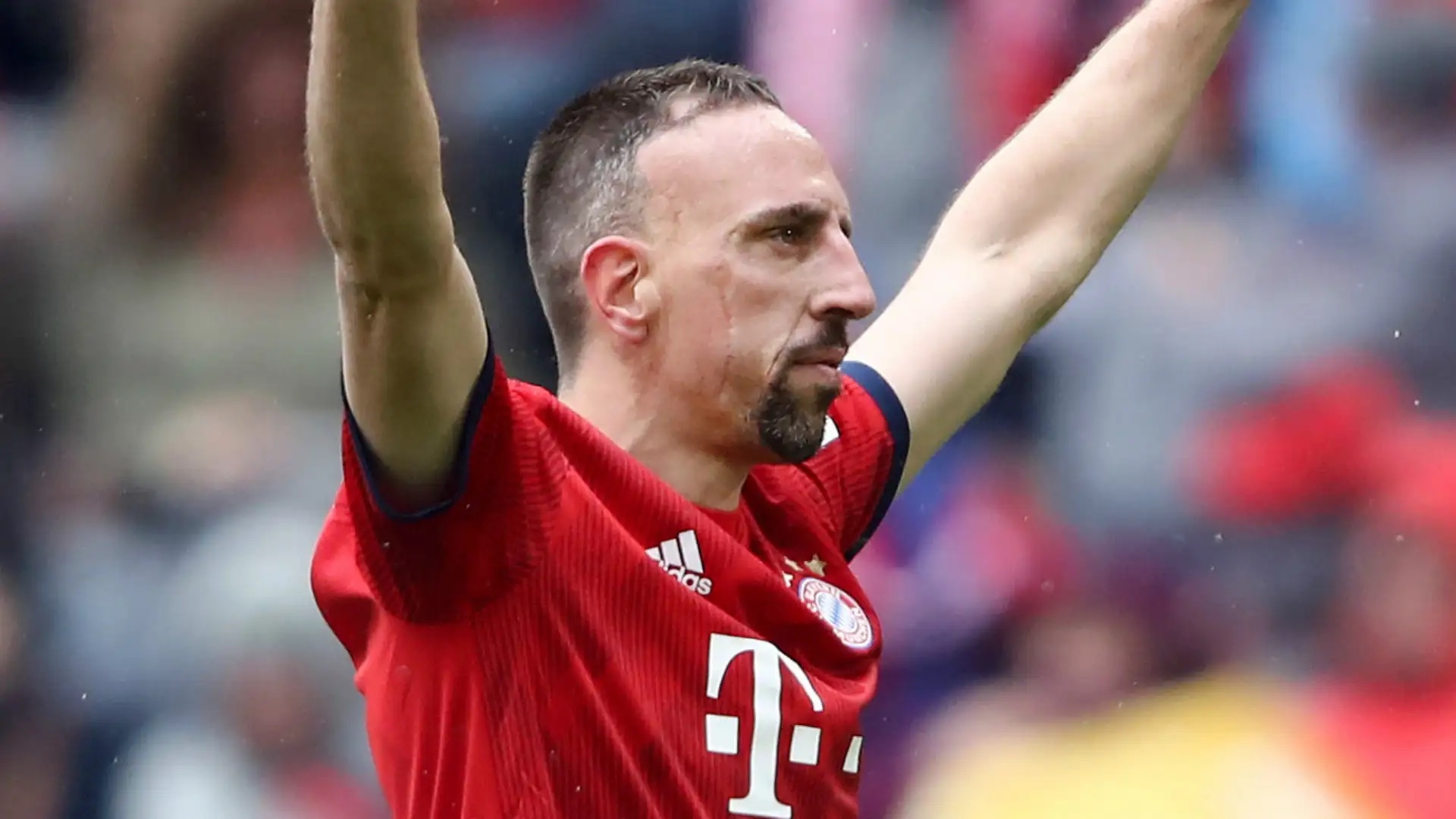
At Franck Ribéry's peak, he was voted UEFA’s best player in Europe, ahead of what the general public believes are the best players in the world: Lionel Messi and Cristiano Ronaldo.
Ribéry was 30 years old when he was playing the greatest football of his life. At Bayern Munich, he had just contributed to them completing a historic treble: Bundesliga, DFB-Pokal, and Champions League winners. Ribéry had recorded a league-leading 15 assists during Bayern’s historic Bundesliga run.
Ribéry was not only a vital player in this extraordinary club run, but he would also be a pivotal component of his national team: France’s 2006 World Cup campaign, coming up as the runner-up team. Bayern would eventually regard him as a club legend.
Yet, long before millions of people recognized Ribéry’s face as one of the world’s best footballers, people stared at the same face for a completely different reason: his facial scars.
Ribéry was born in Boulogne-sur-Mer, France, on April 7, 1983. When he was 2 years old, he was involved in a serious car accident. Accounts depict that he was thrown through or against the windshield, leading to severe injuries and permanent scarring on the right side of his face and his forehead. Ribéry later explained that he was fortunate that he had survived the accident; however, as a two-year-old, he wasn’t yet capable of understanding this and only saw the social side.
Growing up, Ribéry documented other children mocking him and calling him ugly. One particularly cruel nickname he was given was “Frankenstein.” Not only did children treat him differently, Ribéry remembered adults staring at him as well. While recalling the negative memories from the past, he explained that enduring the children’s ridicule and even adults treating him differently required a lot of mental strength. This created a negative mindset that there was something wrong with how he looked.
Before Ribéry became famous, strangers didn’t look at him because he was talented, but because of his face. The psychological effect this had on Ribéry was insane, and might have contributed to his ability to stay calm when he became a professional footballer.
No matter how beneficial overcoming these obstacles was as a child, Ribéry suffered a lot.
He acknowledged that people’s reaction bothered him deeply when he was young, and his family suffered because they had to address the staring and had to console him. At the same time, Ribéry refused to let this negative aspect affect his life, and he didn’t retreat from the obstacle. Ribéry wasn’t the type of person to go home and cry, and he wasn’t going to let something like this affect him.
Growing up in a disadvantaged neighborhood in northern France, unemployment and economic hardship plagued the community. Ribéry described that during adolescence, this environment led him to adapt and become mentally strong. His family lived modestly, and Ribéry remembered that although they sometimes had very little, his father always found a way to provide for his children.
The world tried to evaluate Ribéry by something he could not control. Football gave him something he could control.
Ribéry grew up super competitive and recalled being a fighter who hated losing even when there was nothing at stake. Eventually, people stopped simply seeing the scar and started to see what he could do with a ball.
Despite him being feisty and competitive, his pathway to professional football was far from straightforward. He was released from Lille’s academy as a teenager, and the path he took next would lead to multiple transfers until finally reaching Bayern Munich. After Lille, he returned to lower-level football, and at Brest, he started gaining serious attention and was brought to play in Ligue 1 with Metz in 2004. Within a couple of years, his name would explode on the international stage.
At the 2006 World Cup, Ribéry emerged as one of France’s major players as the team reached the final. Suddenly, the world stopped recognizing him for his face, but for his football skills. Millions of people watched as his skills started defining him. Throughout his career, he ultimately earned 81 French caps and scored 16 international goals.
Bayern signed Ribéry from Marseille in 2007, when he was only 24 years old. This transfer transformed his career from impressive to completely legendary.
Ribéry’s style was explosive, with close control, and very creative. He would remain at Munich for over 12 years.
2013 became the culmination of his story. The boy who was remembered by strangers because of the scar on his face became arguably one of the best footballers in Europe. He had reached a level where his name was ingrained in footballing history.
Even after Ribéry became rich and famous, he didn’t consult doctors or cosmetic surgeons. He chose to keep the scars. He believed that removing the scars would be removing an integral part of his story.
He said:
“I can’t live without this scar.” — Franck Ribéry
Ribéry repeatedly said that these scars gave him strength, formed his character, and made him mentally tougher. He described his journey as something he was proud of.
After leaving Bayern in 2019, Ribéry played for Fiorentina and later Salernitana in Italy before retiring in October 2022 because of knee problems.
At the beginning of his life, people only saw Ribéry’s scars as defining him, something to stare at and judge. At the end of Ribéry’s career, they were proven wrong because what the scars represented wasn’t something to judge, but a symbol of strength, courage, and a footballer who could rival the world’s best.
Share
Share this story
References
Sources
- UEFA — “Franck Ribéry wins UEFA Best Player in Europe award 2012/13” (external link)
- UEFA — Background: Dortmund vs Bayern, 2013 (external link)
- Fédération Française de Football — Franck Ribéry profile (external link)
- German Football Association / DFB Datencenter — Franck Ribéry (external link)
- FC Bayern Munich — The best photos of Franck Ribéry at Bayern (external link)
- WELT — “Franck Ribéry: Diese Narbe hat meinen Charakter geformt” (external link)
- Corriere della Sera — Ribéry on childhood staring and suffering (external link)
- Corriere della Sera Video — Ribéry discussing his scar (external link)
- ZEIT — Franck Ribéry profile (external link)
- The Guardian — Franck Ribéry career timeline (external link)
- 20 Minutes France — Franck Ribéry on his adolescence (external link)
- Sports Illustrated — Ribéry reveals the story behind his scars (external link)